Sorry, you need to enable JavaScript to visit this website.
Skip to main content
European Commission logo

Youth Wiki

Spain

9. Youth and the World

9.2 Administration and governance

Last update: 20 April 2026

Governance

Main actors

Spain’s administration of policies related to “Youth and the World” operates through several ministries and national bodies whose mandates cover international cooperation, external action, sustainable development, climate policy and youth affairs. Coordination between ministries ensures that youth perspectives are integrated across global policy domains, including foreign action, development cooperation and environmental policy (see also Chapter 9.3 for participation mechanisms).

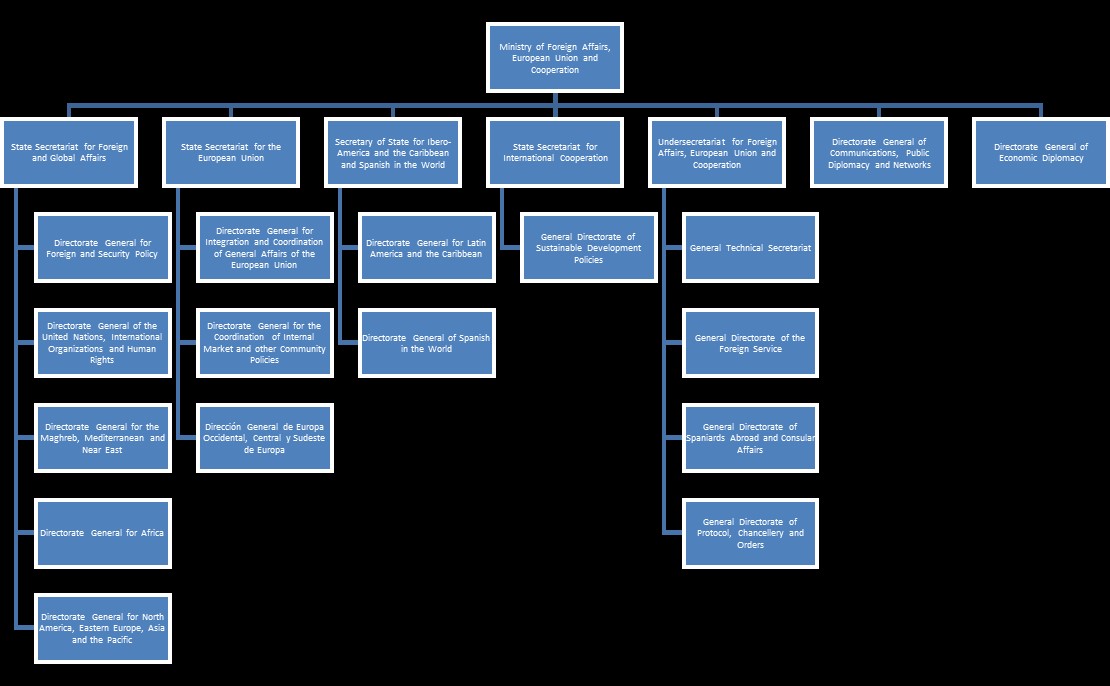
Ministry of Foreign Affairs, European Union and Cooperation (Ministerio de Asuntos Exteriores, Unión Europea y Cooperación, MAUC): Leads Spanish foreign policy and oversees development cooperation through its Secretariat of State and the Spanish Agency for International Development Cooperation (Agencia Española de Cooperación Internacional para el Desarrollo, AECID). MAUC is responsible for planning and implementing Spain’s development cooperation, humanitarian action, and international partnerships. 

Ministry for Ecological Transition and the Demographic Challenge (Ministerio para la Transición Ecológica y el Reto DemográficoMITECO): Designs and coordinates national environmental, climate and energy policies, including environmental education and awareness‑raising initiatives relevant to young people. MITECO also supports environmental volunteering and climate‑related programmes. 

Ministry of Social Rights, Consumers and 2030 Agenda (Ministerio de Derechos Sociales, Consumidores y Agenda 2030): Coordinates the national implementation of the 2030 Agenda for Sustainable Development, including Spain’s Voluntary National Reviews (VNRs). It promotes SDG‑related awareness, participation and education initiatives that directly affect young people’s engagement with global issues.

Spanish Youth Institute (INJUVE):Leads national youth policy, supports youth participation in international programmes, and facilitates mobility and cooperation opportunities for young people. INJUVE collaborates with MAUC, MITECO and Autonomous Communities to ensure youth perspectives are considered across thematic areas.

General distribution of responsibilities

The governance of youth‑relevant global policy areas is distributed as follows:

  • International cooperation and global solidarity are planned and coordinated by MAUC and AECID, setting strategic priorities, coordinating with regional and local authorities and collaborating with civil society organisations active in development cooperation.
  • Environmental policy, climate action and sustainability education fall under MITECO, which collaborates with schools, NGOs and Autonomous Communities to implement environmental awareness and volunteering initiatives.
  • Youth‑specific programmes and international mobility opportunities are coordinated by INJUVE in partnership with Autonomous Communities and national youth councils.
  • SDG coordination and national reporting are the responsibility of the Ministry of Social Rights, Consumers and 2030 Agenda.

Cross-sectorial cooperation

Cross‑sectoral cooperation is essential for linking youth policy with external action, sustainable development and environmental agendas. Coordination takes place through inter‑ministerial mechanisms, joint programmes, and shared participation in national and international councils and working groups. Examples include:

  • Collaboration between MAUC and INJUVE on youth participation in European and international processes (e.g. EU Youth Dialogue cycles, youth delegations in international fora).
  • Shared initiatives between MITECO, INJUVE and Autonomous Communities to promote environmental education, volunteering and awareness‑raising campaigns.
  • Alignment between 2030 Agenda coordination and youth policy to strengthen young people’s engagement with the Sustainable Development Goals. 

These forms of cooperation ensure that policies affecting young people’s engagement with global issues remain consistent across sectors and levels of administration.

Awareness‑raising initiatives coordinated by these actors are presented in Chapter 9.4.