
Sorry, you need to enable JavaScript to visit this website.
Skip to main content
European Commission logo

Youth Wiki

Spain

8. Creativity and Culture

8.2 Administration and governance

Last update: 15 December 2025
On this page
  1. Governance
  2. Cross-sectorial cooperation

Governance

Main actors:

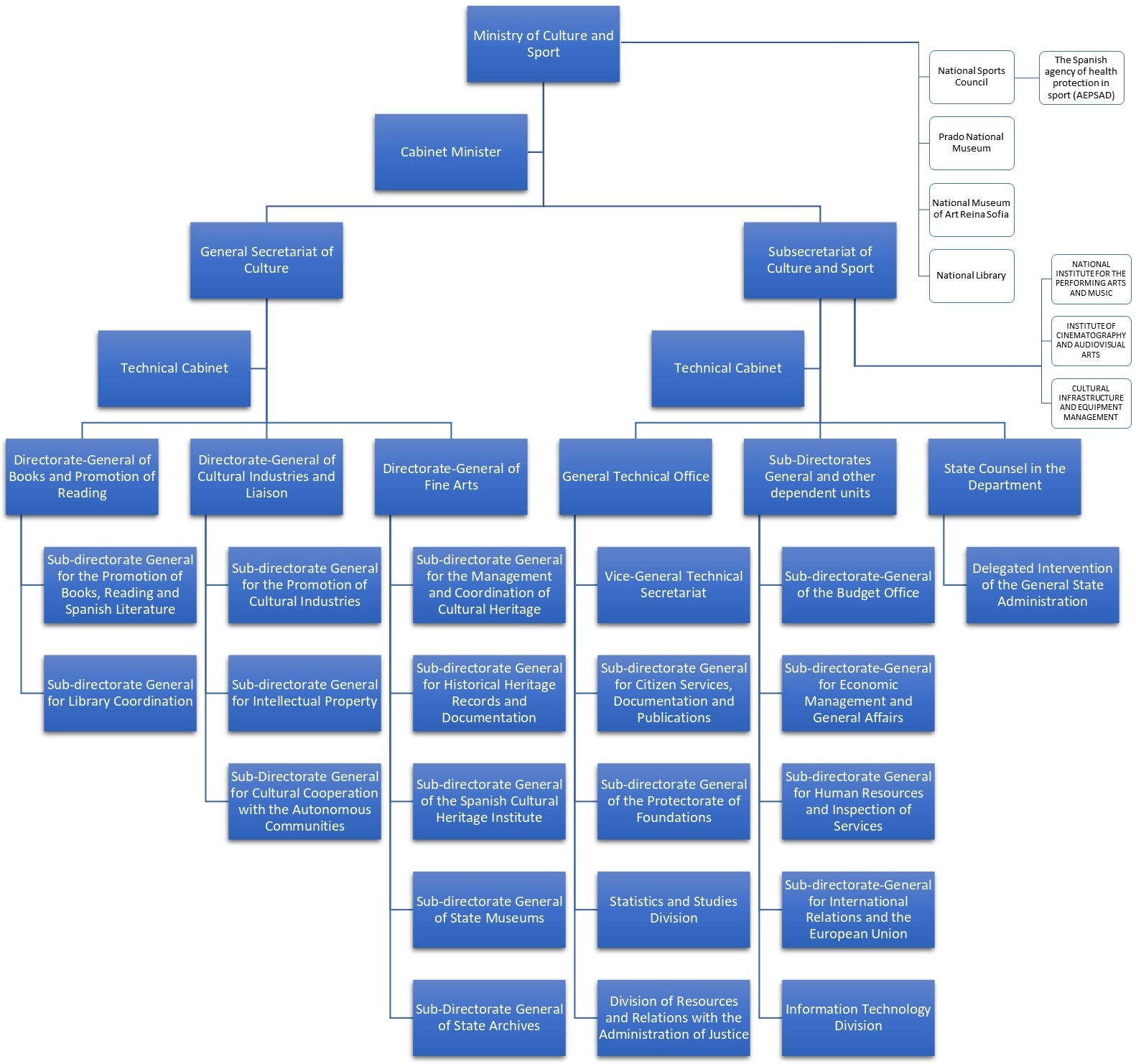
The Ministry of Culture (Ministerio de Cultura) is the central national actor responsible for the formulation, promotion and dissemination of national cultural policies and programmes throughout Spain. It operates under the Secretary of State for Culture and coordinates with the Autonomous Communities, local authorities and cultural-sector stakeholders.

The Ministry is supported by its Directorate General structures, including the newly established Directorate General of Cultural Rights (Dirección General de Derechos Culturales), signalling a stronger institutional focus on inclusion, equality, youth cultural participation and territorial equity.

The Ministry oversees and works in partnership with a number of affiliated state bodies and institutions, including (but not limited to):

These institutions are either directly dependent on or closely coordinated with the Ministry and execute specialised functions in the fields of heritage, performing arts, film, libraries and visual culture.

General distribution of responsibilities

Under Royal Decree 323/2024 (Real Decreto 323/2024), which develops the basic organisational structure of the Ministry, the following key components are defined: 

  • The Secretary of State for Culture, under whose remit fall several Directorates General. For example:
    • the Directorate General of the Book, Comic and Reading
    • Directorate General of Cultural Rights
    • Directorate General of Heritage and Fine Arts
  • The Sub-secretary of Culture, supported by the Technical General Secretariat and its sub-directorates (covering areas such as information resources, archives, economic management).
  • The centres, agencies and public bodies (BNE, GIEC, ICAA, INAEM, MNCARS, Prado Museum) which operate under the Ministry either through dependency or coordination agreements.
  • A cross-cutting mechanism: the Centre for Coordination of Cultural Industries (Centro de Coordinación de Industrias Culturales), depending on the Sub-secretary, which leads policy for cultural industries, digital culture, patronage and coordination when functions cut across departments.

This distribution enables the Ministry to cover regulatory, promotional, heritage-protection, creative-industry and access-to-culture functions within its remit. 

Cross-sectorial cooperation

The Ministry of Culture works closely with other ministries, regional governments and international organisations in implementing cultural policy. 

A key framework is the National Recovery, Transformation and Resilience Plan (Plan de Recuperación, Transformación y Resiliancia), which involves multiple ministries and emphasises public-private collaboration for cultural and creative sectors. 

Through the Sub-directorate General for the Promotion of Cultural Industries (within the Ministry), the cultural sector coordinates with other administrations and the European Union on issues such as cultural-industry support, outsourcing of creative services, internationalisation of Spanish culture and creative export.

Additionally, the establishment of the Directorate General of Cultural Rights strengthens collaboration between culture, education, social policy and youth affairs—bridging sectors to embed cultural inclusion and youth participation.